We’ve all been there. You’ve spent months—maybe years—on a therapist’s couch in a beautiful midtown office or via a grainy screen. You’ve analyzed your childhood, you’ve mapped out your triggers, and you can articulate exactly why you feel the way you do.
And yet, when that certain email hits your inbox or you step onto a crowded L train, that familiar knot in your chest returns. Your heart races, your breath gets shallow, and all that intellectual insight flies right out the window.
In treating clients in New York City, we see this daily. Our clients are brilliant, high-achieving, and incredibly self-aware. But they’re also exhausted by their own insights. They’ve realized a fundamental truth: You can’t always talk your way out of a feeling that is living in your body.
If you’re feeling "stuck" despite doing the work, it’s likely because the source of your distress isn't in your "thinking" brain. It’s deeper. And that’s where Brainspotting comes in.
What is Brainspotting?
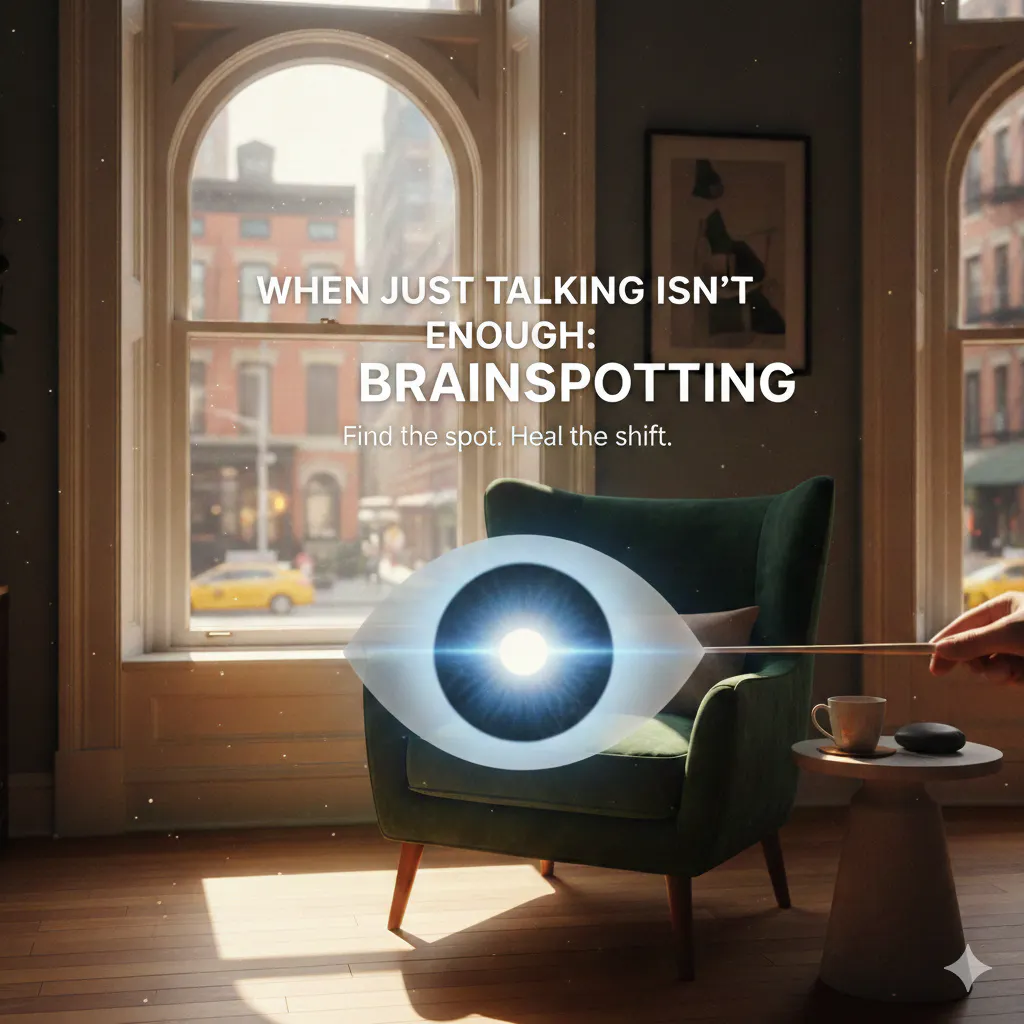
Developed by Dr. David Grand, Brainspotting is a powerful, focused treatment that works by identifying, processing, and releasing core neurophysiological sources of emotional and physical pain.
The guiding principle is simple: "Where you look affects how you feel."
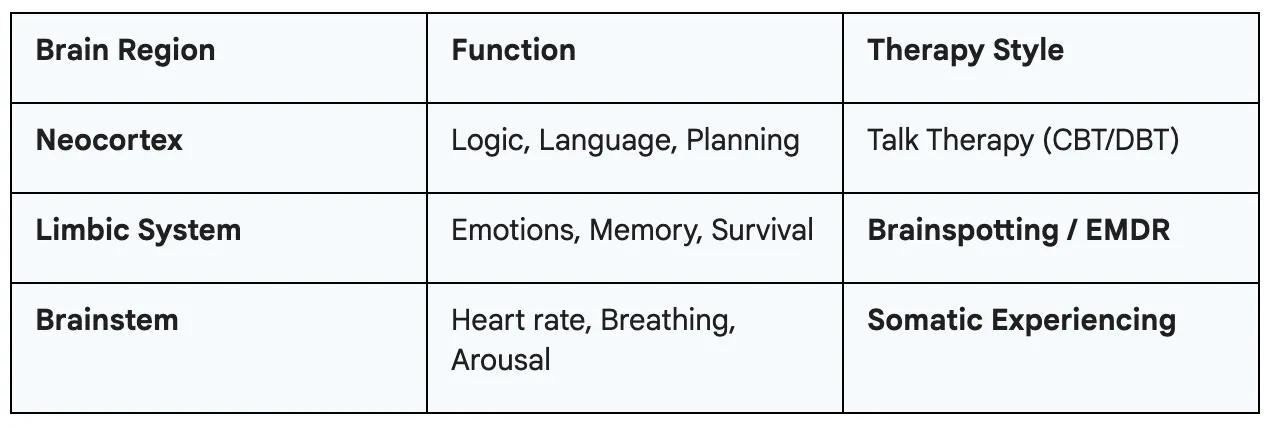
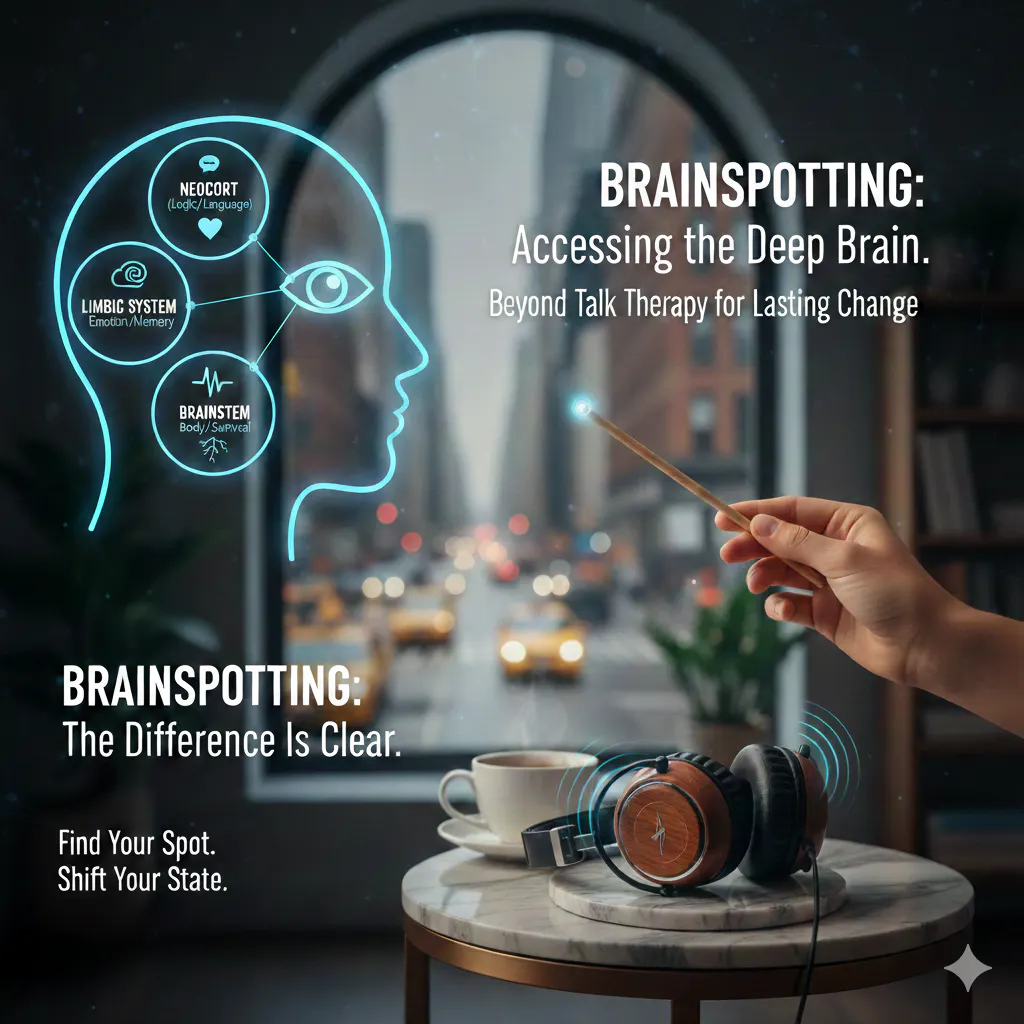
In a typical session, we aren't just chatting about your week. Instead, we use your visual field to find a "Brainspot"—a specific eye position that activates a traumatic memory or a painful emotion. By holding your gaze on that spot, we bypass the "talking" part of your brain (the neocortex) and go straight to the subcortical brain, where trauma and stress are actually stored.
Why NYC Adults Need a Different Approach
New York is a high-stimulus, high-pressure environment. We are experts at "powering through," which often means we’ve become masters at suppressing our nervous system's distress signals.
Traditional talk therapy is wonderful for many things, but Brainspotting offers something different for the New Yorker who:
- Is tired of retelling their story: You don’t have to relive the details out loud to heal the wound.
- Feels "stuck" in their progress: You’ve hit a plateau where you know the "why" but can't change the "how."
- Experiences "Physical" Anxiety: You feel it in your gut, your jaw, or your chest before you even have a conscious thought about it.
- Wants efficiency: Between 60-hour work weeks and a social life, you need a modality that gets to the root quickly.
Brainspotting vs. EMDR: What’s the difference?
Many people ask me if this is just EMDR. While they share a lineage, they feel very different in practice.
- EMDR is highly structured and follows a specific 8-phase protocol. It's often more "top-down."
- Brainspotting is more fluid and intuitive. It’s a "bottom-up" approach that allows your brain to lead the way. It’s less about "reprogramming" and more about "releasing."
What does a session actually look like?
Forget the clinical stereotypes. In The Boundary, a Brainspotting session is a collaborative, quiet, and deeply grounded experience. We might use a pointer to find your spot, or we might simply notice where your eyes naturally wander when you talk about a certain stressor.
Most importantly, we are not the expert on your experience—your brain is. Our job is to hold the space while your system does the processing it’s been trying to do for years.
Ready to get unstuck?
If you’re ready to stop just managing your symptoms and start actually resolving them, Brainspotting might be the missing piece of your puzzle. Schedule a FREE consult with Liat Fruman, LCSW. Liat offers Brainspotting Intensives that are typically 90 minutes - 2 hours in length with a cost of $500 per intensive. Most clients engage in 1-3 intensives for best result.
The Investment: What to Expect
In New York City, specialized brain-based therapies are an investment in long-term regulation rather than short-term "venting." Because Brainspotting often works faster than traditional talk therapy, many clients find it more cost-effective over time.
A Note on Insurance
Most Brainspotting specialists operate as Out-of-Network (OON) providers. This allows us to focus on your specific clinical needs rather than being restricted by insurance company mandates on session length or diagnosis.
Why the higher rate?
Brainspotting requires extensive post-graduate training and a high level of clinical presence. In a city as fast-paced as New York, you aren't just paying for an hour or two of time; you are paying for a specialized process that helps your nervous system keep up with your life.