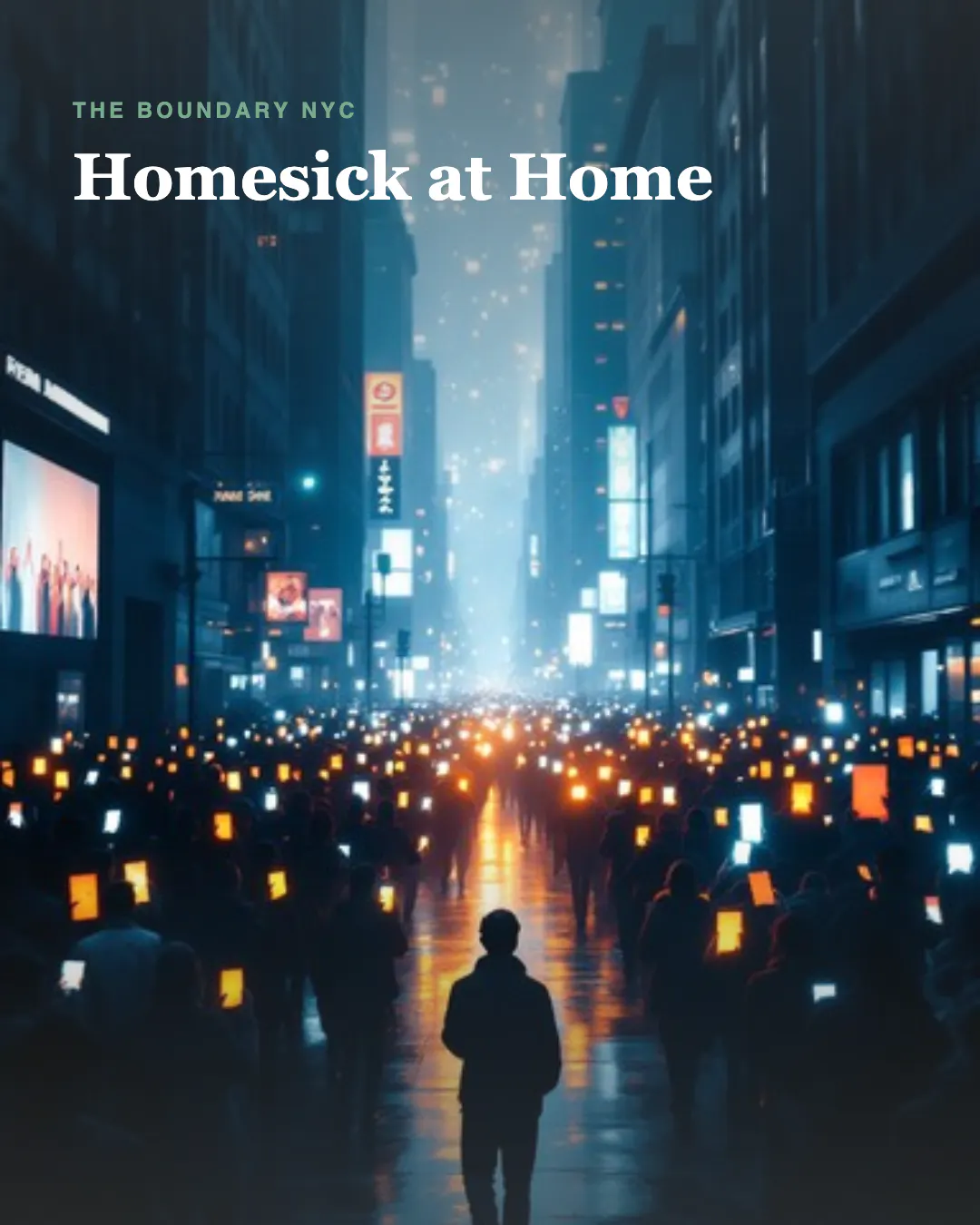
You are physically in your home. Like, you live here. You have a lease, a commute, a coffee order, and at least one strong opinion about which subway line is the worst. America is home, in the logistical sense.
And yet you opened Instagram to watch a World Cup highlight and now it's an hour later and you feel a very specific kind of terrible that you cannot explain to anyone who didn't grow up somewhere else.
That's the thing about the phrase "homesick at home." The home in the title is the U.S. The one you live in right now. And the homesickness is for something else entirely: a place, a language, a version of yourself that exists somewhere your passport is from. Those two things are sitting in the same body right now, and the World Cup, playing out in American stadiums with fans from every country flooding your city, is making that very hard to ignore.
You're not overreacting. This is a real, documented psychological experience. And it has gotten very loud this summer.
Why belonging to two places at once is exhausting (and no one talks about it)
There's invisible work that happens when you live between two cultures. You translate yourself constantly, automatically, in both directions. American enough at work, from home when you call your family, and somewhere in between when you're just trying to get through a Tuesday. You've probably gotten so good at this that most people around you don't even notice you're doing it.
What the World Cup does is activate both of those selves at the same time, in the same place. Your home country's fans are waving flags you grew up under in a stadium you drive past. People speaking your first language are wandering around your neighborhood asking for directions. That is a lot of identity to hold simultaneously, and it is genuinely disorienting.
Psychologists call this bicultural identity integration, which is a very clinical way of saying: you hold two cultural selves, they don't always coexist peacefully, and the work of managing that tension is real even when it's invisible. It is not a character flaw. It's not a sign that you haven't adapted well enough or committed hard enough to the life you've built here. It's just what belonging to more than one world costs, and this particular summer is making that cost very visible.
Why the "shocked foreigner" content hits differently when you're the foreigner
There's a specific genre of video doing enormous numbers right now. Someone from another country encounters American portion sizes for the first time, or the tipping system, or the complete absence of sidewalks, or the way Americans say "we should get together sometime" and genuinely do not mean it, and they react with polite bewilderment. It's funny. It's very relatable. And then something shifts.
When you watch that content and you are the person it's describing, even loosely, it does something a little different than it does for someone watching from a comfortable distance. It's not just funny anymore. It's a quiet reminder that you are a person who had to learn this place as a second language, that there are rooms where you will always be slightly foreign, that the things that feel obvious and normal to you because they are from home still land differently here.
There's also the version that goes the other direction. You find content about your home country and realize you've been gone long enough that things changed without you. The city you grew up in looks different. Your family's routines shifted and you found out on a voice note. You have become, without meaning to, a guest in the place that made you.
That's a specific kind of grief. Not big and loud. Just the slow background ache of living somewhere between.
Homesickness is grief, not weakness
I want to say this clearly: homesickness is not a phase you were supposed to outgrow. It's not a sign you made the wrong call coming here, or that you need to mentally commit harder to the life you've chosen. Homesickness is grief. Real grief, for real things: a place, a language, a pace of life, a way of being in the world that doesn't fully exist anywhere you currently have access to.
And like all grief, it doesn't follow a schedule. It goes quiet for months and then gets set off by something small. A song that was playing at a World Cup your country hosted when you were a kid. Your team winning and having nobody nearby who really gets what that means. A comment section full of people laughing at something your grandmother cooked.
That grief is not you falling apart. It's you staying honest about what you've given up to be here. It deserves to be taken seriously, not explained away with a reminder about how lucky you are.
You can carry the genuine pride in what you've built here and the genuine missing of where you came from. That's not contradiction. That's just what it actually looks like to be a person who has loved more than one place.
How to notice when scrolling shifts from comforting to spiraling
The World Cup rabbit hole starts as one thing and quietly becomes something else.
It starts as connection. Your team scored. You want to see the fans. You want to find the clip of the section that sounds like home and watch it four times because for thirty seconds it kind of felt like you were there. That's a real, legitimate feeling and you're allowed to have it.
And then somewhere in the next forty-five minutes the algorithm has moved you. You're watching content that's making you feel more alone, not less. You're comparing the life you're living to a version of yourself that stayed. You're in a comment section. You are no longer having a good time, but you also haven't stopped.
When you notice that shift (not if, when), here is one actually useful thing to do: name it out loud or in your head. "I was feeling connected and now I feel lonely." "I was laughing and now I feel foreign." "I am looking for something in this app that is not here." You don't have to fix it. You just have to see it clearly.
Because the instinct when you're feeling that ache is to keep going, hoping the next video fixes it. It mostly doesn't. It usually makes the ache more specific and a little harder to put down.
What actually helps is boring: close the app. Text someone who gets it. Call someone from home. Find a bar full of strangers who speak your language and watch a game together. Eat something that tastes like where you're from. These are not sophisticated interventions. They are just the real antidote to what a grief-activating algorithm does to your nervous system when you're already a little tender.
Frequently asked questions
Is it normal to feel homesick during the World Cup even if I've lived in the US for years?
Yes, completely. Major events tied to national identity have a way of activating belonging feelings that don't care how long you've been somewhere. If your home country is playing and you're watching from a place that isn't your home in the emotional sense, that gap can feel very real very fast, even if you haven't felt it in months. Time here doesn't erase where you're from.
Why does the "foreigner reacts to America" content bother me even when it's supposed to be funny?
Because when you are the foreigner it's describing, those videos are not entirely a joke. They're a fairly accurate account of adjustments you actually had to make, and probably still make quietly every day. Comedy about cultural difference hits differently when you're the one who did the translation in real life. You're allowed to not find it funny even if everyone else does.
I've been in America for ten years. Why does something like this still get to me?
Because acculturation adds layers, it doesn't erase what came before. You can be genuinely settled somewhere and still carry grief for the place you left. Big cultural moments have a way of surfacing feelings that were quiet. That's not a sign you haven't adjusted. That's a sign you're paying attention.
Is it possible to love living in America and still feel homesick?
Yes. Those things coexist without contradiction more often than people admit. Choosing this life doesn't mean forfeiting the right to miss somewhere else. You can be grateful for where you are and also grieve what you're far from. Both are real.
My family is watching the World Cup together back home and I feel left out even though I'm watching the same game. Why?
Because you're probably watching it alone in the wrong timezone. The shared physical experience, the chaos, the food, the arguing, none of that travels over a video call. Watching the same match from different countries is not the same as watching it together, and the absence of the together part is real. That's one of the quiet costs of living far from the people who feel most like home.
What does "third culture" mean and could it apply to me?
Third culture refers to people who grew up between two or more cultural contexts, often children of immigrants or people who moved countries young. It describes someone whose internal cultural framework doesn't fully belong to either place they come from. If that resonates, it probably applies to you, and it helps explain the feeling of being slightly foreign in both directions.
I feel irritable and sad after World Cup scrolling and I don't know why. Is something wrong with me?
Nothing is wrong with you. What you're describing sounds like a grief response or a belonging wound getting activated by the content. If it's mild and passes in a day or two, that's situational and makes complete sense. If it lingers, or comes with persistent low mood, disrupted sleep, or a general sense of pointlessness, those are worth talking to someone about.
How do I find a therapist who actually understands the immigrant or first-generation experience?
Ask directly in a consultation. A therapist who works in this area should be able to tell you specifically about their experience with cultural identity and acculturation, not just say they're "culturally sensitive." At The Boundary, we have a number of bi-lingual therapists who specialize in multicultural adults
The World Cup is supposed to be fun. Why is it making me feel worse?
Because joyful things can contain grief. Something can be genuinely exciting and also stir up loss at the same time, and both responses are valid. If the World Cup is activating something about where you belong and where you wish you were, it's going to make the fun parts feel a little bittersweet. That's not you ruining it. That's you being honest about what's real.
Is there a difference between being homesick and having depression?
Yes, though they can overlap. Homesickness is usually contextual, tied to a place, a person, a time of life, and tends to activate around specific triggers like this one. Depression is more pervasive. It colors everything regardless of what's happening externally and tends to stick around. If your low mood is specifically connected to World Cup content and thinking about home, that's likely grief. If it's bleeding into everything and won't lift, that's worth bringing to a therapist.
Did it hit?
If this post landed somewhere real for you, we want you to meet one of our therapists.
Head to theboundarynyc.com to learn more about our bilingual and culturally-focused therapists and book a free phone consultation.